
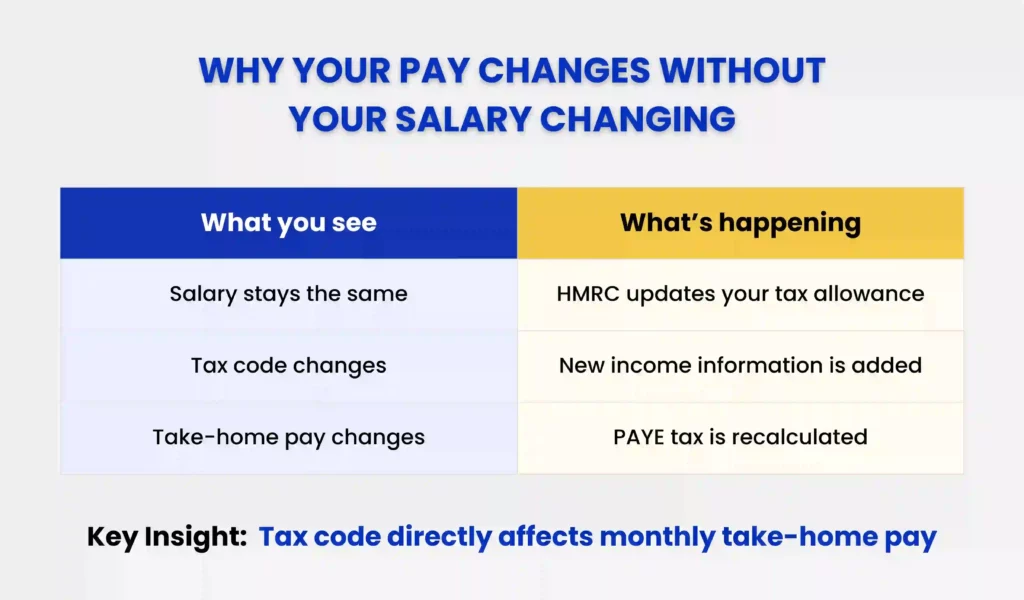
It is a Tuesday morning in 2026. You sit at your kitchen table, the steam from your coffee swirling in the early light, and you open your banking app to check if your salary has landed. It has, but something is wrong. The figure is smaller than last month—not by a massive amount, but enough to notice. You check your digital payslip, and there it is: a different combination of numbers and letters where your tax code used to be. You realise your tax code changed, and suddenly, your financial plans for the month feel a little less certain.
This scenario is becoming increasingly common. Whether it’s a notification through the HMRC app or a surprise on your payslip, a change to your tax code can feel like a bureaucratic mystery. You might find yourself asking, “Why has my tax code changed?” without any obvious shift in your life. The reality is that in 2026, HMRC’s systems are more interconnected than ever, and even small fluctuations in your financial life can trigger an automatic adjustment.
Why Has My Tax Code Changed?
When you see your tax code changed, it’s easy to feel a sense of dread. For most of us, our tax code is the silent gatekeeper of our take-home pay. It tells your employer or pension provider how much tax-free income you’re entitled to and how much should be sent to HMRC before the money even hits your account.
If you are asking, “Why has my tax code changed?” the answer usually lies in a discrepancy between what HMRC thought you would earn and what you are actually earning or if there is any other income you have started to receive. In 2026, these changes are often driven by real-time data sharing between banks, employers, and government departments. While the goal is to ensure you pay the “right” amount of tax, the timing and execution can often lead to confusion.
Why HMRC Changed Your Tax Code
HMRC doesn’t change your code to be difficult or malicious; they do it because their records suggest your current code will result in you paying the wrong amount of tax by the end of the year. Here are the primary drivers behind these adjustments in 2026.
Changes to Your Income or Employment
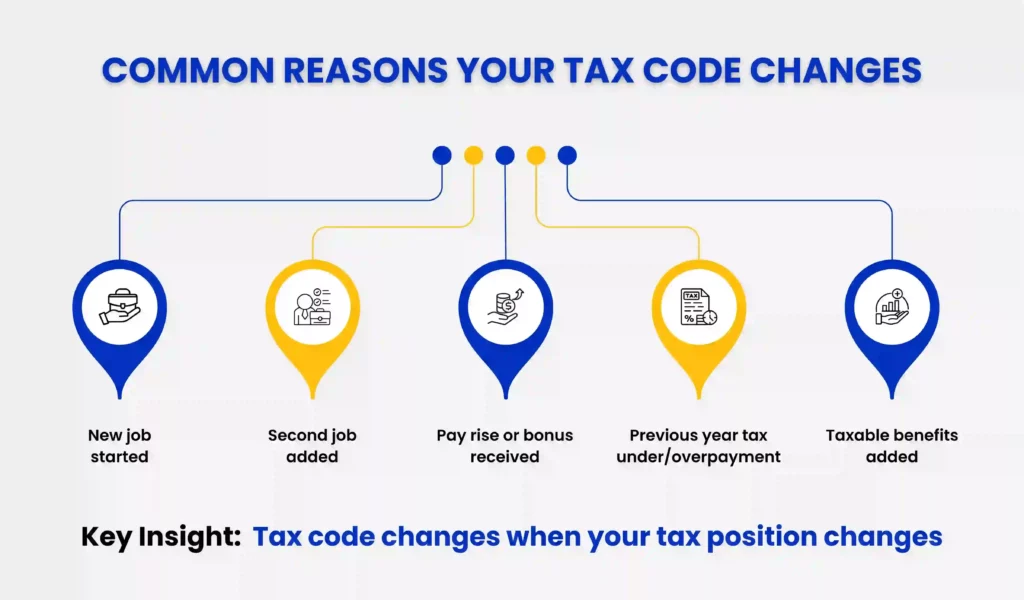
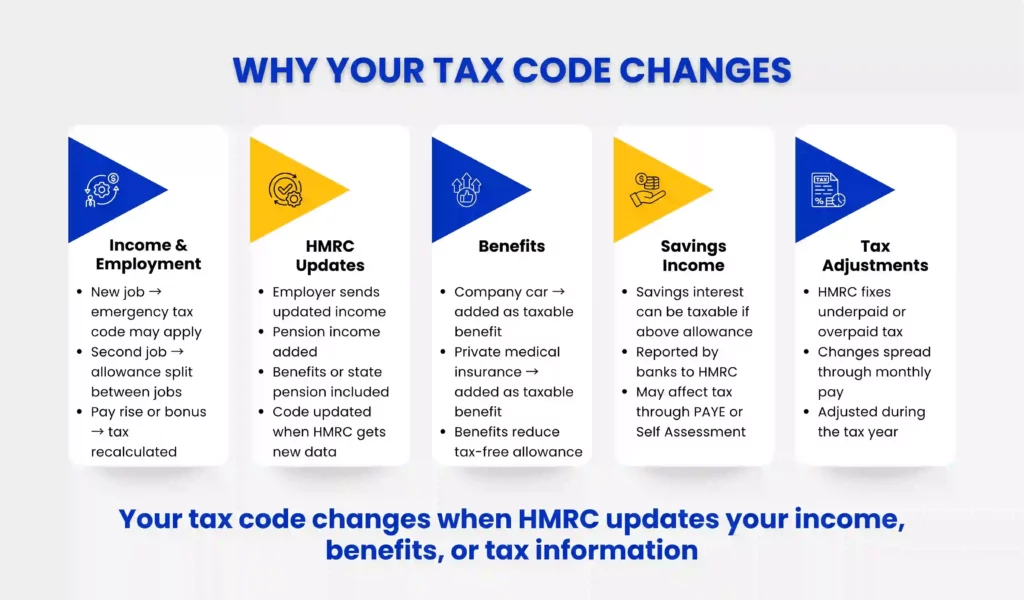
The most frequent reason your tax code changed is a shift in your professional life. If you’ve started a new job, HMRC might put you on an emergency tax code until they receive your P45 details from your previous employer. Similarly, if you have taken on a second job or a “side hustle” that has been reported via the new digital platform rules, HMRC may split your Personal Allowance across two different codes to prevent a large bill at the end of the year. Even a significant pay rise or a one-off bonus can trigger a change, as it might push you into a higher tax payer bracket, requiring a different code to collect the correct amount of tax throughout the remaining months of the tax year.
HMRC Updated Information About You
In 2026, HMRC is utilising more sophisticated data-matching technology. They may have received updated information from other government departments or third parties that contradicts your previous filing. For example, if you have started receiving a state pension or other taxable benefits, this information is now fed more rapidly into the tax coding system. If there was a lag in this information previously, the 2026 updates are designed to close that gap, often resulting in a sudden notification that your tax code changed.
Benefits, Expenses and Allowances Changed
If you enjoy “perks” at work, like a company car or private medical insurance, these are considered “benefits in kind”. Because you aren’t paying for these out of your taxed income, HMRC reduces your tax-free allowance to compensate. If the value of these benefits increases—perhaps you upgraded to a newer car model, or your insurance premiums rose—HMRC will adjust your code downwards. On the flip side, if you’ve recently claimed professional subscriptions or flat-rate job expenses, your code might change to increase your tax-free threshold.
Savings and Investment Income Affected Your Tax Position
One of the most significant shifts in 2026 involves how savings interest impacts your tax position. With interest rates remaining a key factor in household income, many people are exceeding their Personal Savings Allowance. Banks now report interest earned directly to HMRC. If you’ve earned significant interest, HMRC may change your tax code to collect the tax due on that interest through your monthly salary, rather than waiting for you to file a Self-Assessment return. This is a common reason why people see their take-home pay drop even when their salary stays the same.
New HMRC Updates and Tax Code Changes
The 2026-27 tax year introduced specific administrative updates aimed at reducing the number of people who end the year with an “underpayment”. HMRC is now more proactive in “estimating” your end-of-year position based on your year-to-date earnings. If the system predicts you will owe more, it triggers an automated change. While this is meant to be helpful, it can lead to frustration if the system’s “estimate” doesn’t account for upcoming changes you know are happening, but the system is unaware.
Common Situations Where People Get Confused About Tax Code Changes
Understanding the theory of tax codes is one thing, but experiencing it is another. You might find yourself in one of these common 2026 scenarios.
“My Tax Code Changed But Nothing Changed at Work”
This is perhaps the most frustrating situation. You’re in the same job, on the same salary, with the same benefits. So, “why has my tax code changed?” In this case, the change is almost always due to “third-party data”. It could be the interest from a savings account that’s tipped you into HMRC savings tax warning territory, or perhaps an adjustment for a previous year’s underpayment that HMRC has finally processed.
“My Take-Home Pay Suddenly Dropped”
If your tax code changed and your net pay decreased, it’s usually because your tax-free Personal Allowance has been reduced. This happens if HMRC believes you have “untaxed income” coming from elsewhere, such as a landlord’s rental property or investments, and they are using your main job to collect that tax.
“HMRC Changed My Tax Code Because of Savings Interest”
In 2026, the threshold for direct reporting is lower. If you have a tidy sum in a savings account, the interest can quickly eat into your tax-free allowance. HMRC treats this interest as income. By changing your tax code, they ensure the tax is paid gradually over the year.
If your savings interest is what’s triggering the change, moving some of it into a tax-free wrapper can stop the problem recurring next year. See our guide to Tax-Free Savings Accounts in the UK for ISA, Premium Bond, and NS&I options beyond the obvious.
“My Tax Code Changed Before the New Tax Year Started”
HMRC often issues “P2” (Notice of Coding) forms in the months leading up to April. This is a proactive step to ensure that from day one of the new tax year, you are on the correct path. If you receive a notice in February or March, it’s usually an instruction for your employer for the upcoming year.
“I Received a Tax Code Notification But Cannot See Any Difference”
Sometimes a code change is minor—perhaps a few pounds’ adjustment to a benefit value. In some cases, the code might change from an “L” to a “T” or “N” code without shifting the numerical value significantly. This might happen if HMRC needs to manually review your account or if you have opted to transfer part of your allowance to a spouse.
What Is a Tax Code and Why Does It Matter?
To keep it simple: your tax code is a shorthand instruction to your employer. The numbers usually represent how much you can earn tax-free (e.g., 1257L means £12,570 of tax-free income). The letters tell HMRC your status—”L” is the standard, while “BR” means you are being taxed at the basic rate on all income from that source.
It matters because if the code is wrong, you either overpay — meaning you could be due a tax refund — or underpay (resulting in a scary letter and a demand for a lump sum later).
What a Tax Code Change Means for Your Income and Savings
When your tax code changes, it essentially rebalances your relationship with the Treasury. For your income, it means a direct shift in your monthly cash flow. For your savings, it means that the “gross” interest you see in your bank account is being “netted off” through your payroll. In 2026, managing this is vital for accurate budgeting. You need to know that your savings are “costing” you a portion of your monthly salary, so you aren’t surprised when your bills come due.
How to Check Whether Your Tax Code Change Is Correct
You should never assume HMRC is 100% correct. Their systems are automated, and “junk data in” leads to “junk codes out”.
- Check your Personal Tax Account: Log in via GOV.UK or the HMRC app. It will show you exactly what income and benefits HMRC thinks you have.
- Compare with your Payslip: Ensure the code on your payslip matches the one HMRC says you should have.
- Verify your Benefits: Check your P11D (if you get benefits from work) to see if the values match what’s in your tax code.
What To Do If Your Tax Code Looks Wrong
If you look at the breakdown and realise HMRC thinks you still have a company car you gave back six months ago, you must act.
- Update your details online: The quickest way is through the “Check your Income Tax” service on the HMRC website.
- Call HMRC: If it’s complex, you may need to speak to an advisor, though be prepared for wait times.
- Tell your employer: Once HMRC updates their system, they will send a digital notice to your employer, but it can take a full pay cycle to kick in.
If your tax code doesn’t match your circumstances, it’s worth getting a second pair of eyes on it before the next pay cycle locks it in. Our Income Tax Services team can review your coding notice and flag errors before they cost you.
How HMRC Tax Code Changes Are Becoming More Automated
We are moving toward a “frictionless” tax system. In 2026, HMRC is increasingly using AI to spot patterns in your earnings. If you consistently earn more than your base salary due to overtime, the system might automatically “trend” your tax code to prevent an underpayment. While this reduces the need for manual Self-Assessment for many, it requires you to be more vigilant about checking the system’s logic.
How Julian Hobbs Can Help If Your Tax Code Changed
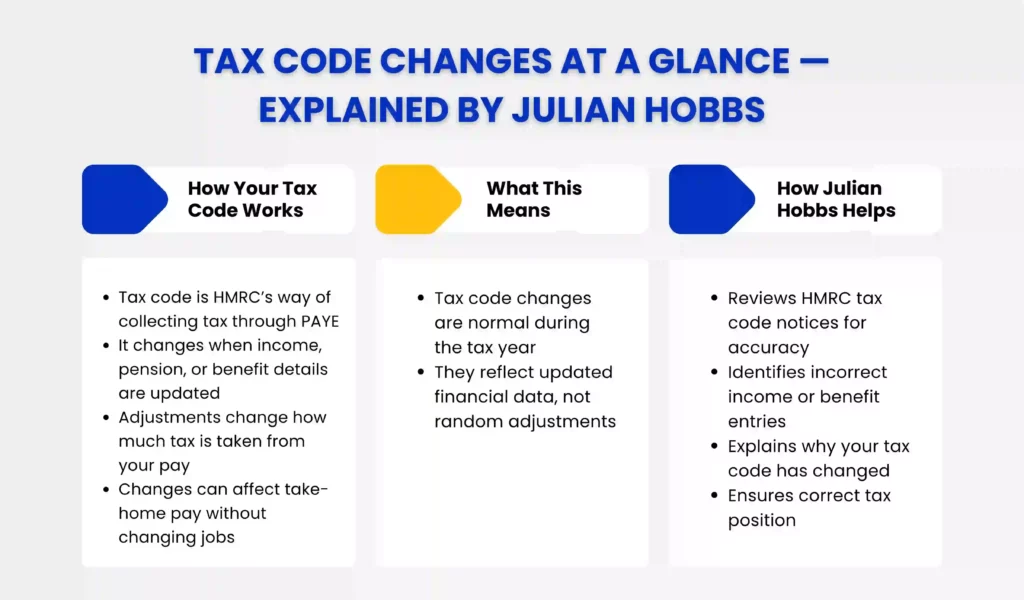
Navigating the complexities of HMRC can be overwhelming, especially when your tax code changes without a clear explanation. At Julian Hobbs, we specialise in untangling these digital knots. Whether it’s reconciling multiple income streams, ensuring your savings interest isn’t being double-counted, or disputing an incorrect adjustment, we provide the expertise to ensure you only pay what you owe. We can review your coding notices and liaise with HMRC on your behalf, giving you back the peace of mind that your “take-home” pay is exactly what it should be.
People Also Ask:
Why has HMRC changed my tax code?
HMRC changes your code if they receive new information about your income, benefits, or untaxed earnings (like savings interest) that suggests your current tax deduction is incorrect.
Why has my tax code changed without warning?
Because of real-time reporting, changes can happen as soon as new data (like a bank interest report) hits HMRC’s system. You should receive a notification via your Personal Tax Account or post, but sometimes the system moves faster than the mail.
Can savings interest change my tax code?
Yes. In 2026, this is very common. If you exceed your Personal Savings Allowance, HMRC often adjusts your tax code to collect the tax due on that interest through your wages.
Does a tax code change mean I owe more tax?
Not necessarily. It often just means the way you pay the tax is changing. However, if your code decreases, it usually means HMRC has identified income that hasn’t been taxed yet.
Why did my take-home pay change after my tax code changed?
Your tax code determines your “tax-free” pay. If the code goes down, your tax-free allowance decreases, meaning more of your salary is subject to tax, resulting in lower take-home pay.
How do I check if my tax code is correct?
Log into your HMRC Personal Tax Account and review the “Income from Employment” and “Untaxed Income” sections to see if the figures match your actual circumstances.
Can HMRC change my tax code before the new tax year?
Yes, they frequently issue “annual coding” notices in February and March to prepare for the new tax year starting in April.
What should I do if HMRC changed my tax code incorrectly?
You should update your details immediately via the GOV.UK website or contact HMRC directly to provide the correct information.
How can Julian Hobbs help if my tax code changed?
We can perform a full audit of your tax position, identify errors in HMRC’s data, and handle the communication with HMRC to get your code corrected swiftly.
