

Before we move on to how to read management accounts, let’s again make this fact crystal clear – your annual statutory accounts are a legal requirement, while your management accounts are a survival tool. Its purpose is to help senior management make informed decisions and prepare for future budgeting & forecasting.
If you are among them – whether a business owner, MD or manager, and you receive a set of management accounts, wondering what you’re supposed to do, then you’re not alone.
Oftentimes, these reports are presented in thick stacks of numbers, charts and unfamiliar terms, leaving you completely overwhelmed. Many directors just glance at the bottom line, check the bank balance, which hasn’t turned red, and move on. They miss opportunities every single time.
Nevertheless, this guide will walk you through how to read management accounts in plain English – no jargon, no unnecessary complexity. By the end, you’ll know exactly what to look for, what questions to ask your management accountant, and how to use these numbers to run a smarter business. We will be sticking to the ideal of management accounts, which is to tell a story, where less is more.
Start Here – The Reading Order That Makes Management Accounts Click
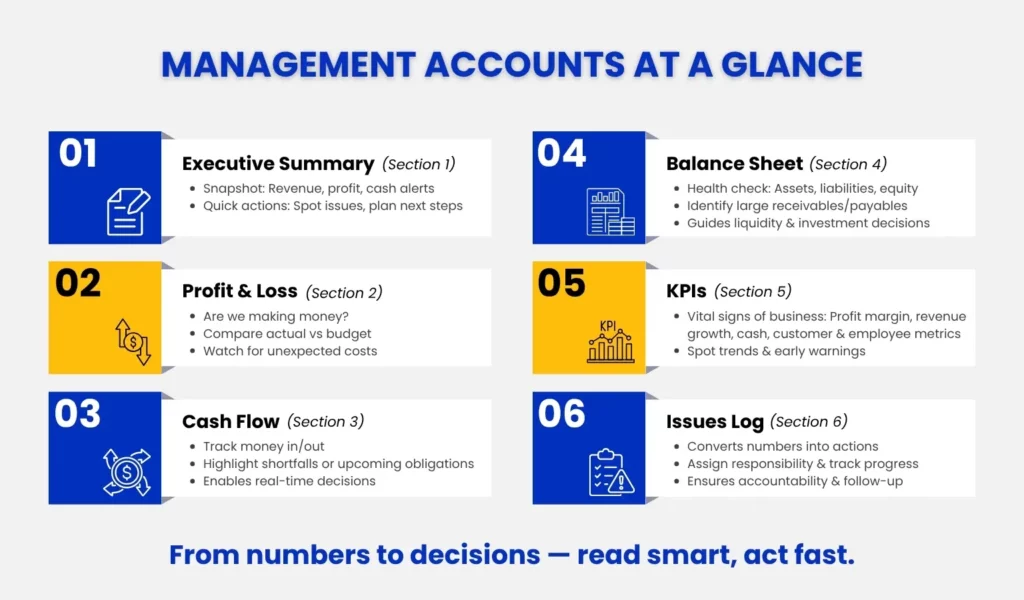
Begin reading management accounts in the order outlined below to make sense and progress from perplexity to total clarity.
- Executive Summary – this is your headline
- Profit & Loss – which tells your performance story
- Cash Flow – which reveals liquidity
- Balance Sheet – captures your business’s health
- KPIs – tell you what actually matters for your business, and signal trends & warnings.
Let’s proceed. You can have a visual look at it with our management accounts example blog.
Section 1 – The Executive Summary: Get the Headline First
This is the front page of your company’s newspaper, highlighting key insights like what has happened and whether you are on track this month. Think of it as a director’s brief before meeting – prepared by the finance team, or in rare cases by dedicated management accountants (a sign rare to see.. But must for absolute sustainable success)
It typically covers:
- Revenue performance versus budget –Are income and expenditure broadly in line with the budget?
- Gross and net profit position – Are there unexpected surpluses or deficits?
- Cash position and any notable movements – Is cash flow sufficient for upcoming obligations?
When a Hertfordshire construction business’s MD received its management accounts, the report showed that revenue was up by 12% and subcontractor costs by 8%. The revenue was ahead of budget, which was good news. But labour costs were higher as invoice processing had been delayed. This insight allowed the MD to make quick decisions like: delay non-essential spending, renegotiate subcontractor contracts and hold cash reserves to prevent potential cash problems.
These at-a-glance snapshots help even non-finance owners see things and identify where actions might be needed. If your executive summary doesn’t give this clarity, then you need to have a conversation with your accountant.
Section 2 – The Profit & Loss: Are You Actually Making Money This Period?
Your quarterly or monthly management accounts must include a snapshot of the P&L report showing whether the business has made or lost money.
It should be able to tell you whether your sales are on target. Are there any unexpected costs? And how does it compare to your budgeted expectations?
Management accountants worth their salt will highlight these automatically. They will translate whether the organisation’s activities are money-making or losing, what’s left after everything, and whether you are ahead? Behind? And Why?
When a London-based tech startup saw strong sales for a month, they thought they were making profit. But after management accounts showed that marketing costs and other infrastructure costs had grown by 18% – higher than budgeted, they came to realise the profit was lower than expected.
On its own, the revenue looked brilliant, but in context, margins were being eroded. Management accounts flagged this early, allowing the business to revise its pricing model and reduce spend for the following month.
If you’d like to understand how these figures are calculated before they reach you, our step-by-step management accounts preparation guide covers the full process.
Section 3 – The Cash Flow Statement: The Section That Saves Businesses
You might have heard of businesses that went under. Oftentimes, the reason is almost the same – they ran out of cash.
Cash flow is the lifeblood of any business. When you can see the money movement, you can make real-time decisions.
The management accounts provide a clean snapshot of this, easily answering the question: Is cash arriving when expected? Are outgoing payments aligned with incoming revenue? And are there looming large outflows that could cause a shortfall? They help with cash flow forecasting, guaranteeing liquidity & supporting brutal real decisions.
When Emma, who runs a small startup in Welwyn, sees her monthly cash flow statement, she notices that supplier payments are due, but her important client’s invoice is yet to be paid. She negotiates a short-term delay with the supplier and follows up with overdue clients to collect the unpaid amounts
For businesses where cash flow is a recurring pressure, our dedicated cash flow service provides forward-forecasting as part of every monthly pack.
Section 4 – The Balance Sheet: Your Moment-in-Time Health Check
While your P&L, also known as the income statement, indicates the performance over a specific period (usually a month, quarter, or year), the balance sheet reveals the business position at a specific point in time (e.g., 31 March 2026)
It shows you your assets (what you own), liabilities (what you owe) and equity (cumulative value of the business after all liabilities are settled).
When going through this section of the management accounts, check for receivables – are large amounts owed, and who is chasing them? Payables – What do you owe, and when? And cash and other balances – are they being used effectively?
From determining whether the business is liquid to shaping strategic options around long-term liabilities management, this section lets you know your company’s financial position at a glance. It also advises on investment of surplus cash—perhaps into director pensions or a business savings account. To learn more about tax-free savings options for individuals and businesses, check out our dedicated blog – The Ultimate Guide to Tax Free Savings Account in the UK: More Than Just ISAs
When a London-based digital agency received its management accounts, it could clearly see that it was making a good profit. However, the analysis of the balance sheet revealed that nearly £195,000 was owed by clients – almost three months’ worth of revenue. Hence, the MD was able to plan for payment terms. Hadn’t the balance sheet flagged this, the MD wouldn’t know by simply seeing the P&L.
Section 5 – The KPI Dashboard: Your Early Warning System
Your management accounts are incomplete without KPIs governing your actions.
Both financial and non-financial KPIs are vital for your business. Whether it be gross profit margin, revenue/sales growth, cash liquidity or inventory turnover, or simply customer satisfaction and employee retention, these KPIs tell you what really matters for business success.
Remember, all KPIs (Key Performance Indicators) are metrics, but not all metrics are KPIs (acc to NCVO)
When a UK manufacturing business tracked overall production numbers (a metric), but focused on profit per unit and on-time delivery rates as KPIs, it quickly spotted a drop in delivery performance. The management was then able to adjust schedules and resources before the problem escalated, thereby improving the business’s profitability.
Section 6 – The Issues Log: Where Reporting Becomes Accountability
The issue log, sometimes called commentary or action register, is where reporting moves from numbers on a page to real business action. Too often, teams create reports but leave this section empty or ignore it entirely.
A good management account includes an issue log that flags problems early, assigns responsibility, tracks progress, and highlights where management intervention is needed.
When an engineering firm in Watford issued a log in February that read: “Gross margin fell 4% due to material price increase. Finance to remodel the pricing schedule by 10th March. MD to review supplier agreements by month’s end.“By March, the log confirms the pricing schedule has been updated, and the margin has recovered to 33%.
Without the issues log, the P&L just shows a margin dip and recovery with no explanation. With it, you’ve got a management process — accountability, ownership, and evidence that the business responded intelligently to problems.
If your management accounts don’t have this section, introduce it. It changes meetings from information-sharing exercises into decision-making sessions.
The 8 Questions to Ask Your Accountant After Reading Your Pack
- Are my income and expenditure in line with the budget?
This is an important question that helps you see whether the business is performing as planned – comparing what has happened against what was planned, and whether the spending and revenue are in alignment with your financial plan.
- Is our gross margin holding?
Margin erosion is often silent and cumulative. Catching it monthly means you can act before it’s structural. - What does our cash position look like over the next 90 days?
Historical cash flow is useful, but a rolling 13-week forecast is invaluable.
- Are there any debtor balances we should be concerned about?
One large bad debt can unwind months of profit. Know before it’s written off.
- What’s our current run rate, and are we on track for year-end?
Understanding the trajectory helps you make capital and hiring decisions with confidence.
- Are there any tax liabilities building that we need to plan for?
This is about spotting any upcoming tax bills before they become a surprise. Corporation tax, VAT, and PAYE all have timing implications that your balance sheet will show if you know where to look.
- Which KPIs are trending in the wrong direction?
A good management accountant will flag these proactively, so you can see what’s slipping and take early action.
- Is there anything in these accounts that concerns you that we haven’t discussed?
This open question often brings out the most important insights from the meeting and gives you peace of mind that nothing important has been overlooked.
Red Flags – What Should Prompt an Immediate Conversation
Following are a few of the triggers to act on immediately:
- Gross margin falling three months in a row — pricing, costs, or both need urgent review
- Cash position declining despite profitability — collections, payment terms, or overtrading
- Debtor days rising above your payment terms — the collection process is breaking down
- Overhead costs growing faster than revenue — cost base is becoming unsustainable
- Net assets turning negative — the business may be technically insolvent
- KPIs diverging sharply from prior periods without explanation — something has changed operationally that finance hasn’t captured yet
None of these are reasons to panic – but all of them are reasons to act promptly rather than wait for next month’s pack.
Common Mistakes Business Owners Make When Reading Management Accounts
Even experienced business owners fall into these traps:
- Focusing only on profit, while ignoring the cash flow. This is the least actionable number in the whole pack. Try shifting focus to margin, cash and trends.
- Overlooking non-financial KPIs. Metrics like customer satisfaction, staff turnover and on-time delivery- among other non-financial KPIs- have a big impact on overall performance and, eventually, your bottom line.
- Not asking “why” for variances. A number being off isn’t the problem; ignoring the reason behind it is. Asking ‘the why’ helps you fix issues before they grow and cripple your business.
- Relying solely on quarterly reports for fast-paced businesses. While your business waits for historical reports, the issues slowly creep into your structural framework. Regular, even monthly or weekly assessments can prevent this by spotting trends early on- and making informed decisions.
- Treating management accounts like statutory accounts. Unlike statutory accounts, management accounts are for running your business, not just filing paperwork.
Conclusion
As a manager, MD or decision-making body, you need to know how to read management accounts. But this does not signify that you need to understand the numbers like your accountant. A good management account tells the story without jargon and unnecessary complexity, focusing on metrics that matter most.
It includes
- Executive summary = headline
- P&L = performance story
- Cash flow = liquidity check
- Balance sheet = snapshot of health
- KPIs = vital signs, and
- Issues log for accountability
If you don’t have management accounts or clue on tracking the right metrics, then partnering with Julian Hobb’s management accountants can make a big difference. Not only do you get actionable insights and strategic recommendations- based on your business type and stage, but also a simple, clean report that you can confidently present to your stakeholders.
We work with businesses across Welwyn, Hertfordshire and nearby regions to help set the rhythm to their business – one where less is more; action is proactive, and result is extraordinary. Book a call with our team today, and get custom-tailored support you can count on.
FAQs: Frequently Asked Questions
How do you read management accounts for the first time?
We begin with the executive summary, then the P&L, cash flow, balance sheet, KPIs, and issues log.
What is the most important part of management accounts?
The most important part of management accounts is its executive summary, cash flow, and KPIs.
What should I look for in a P&L statement?
Look at how revenue is stacked against your budget, watch for expense anomalies and overall profit and loss.
What does a red flag look like?
Sudden falling of gross margin for three months in a row, cash position declining despite profitability, debtor days rising above your payment terms, overhead costs growing faster than revenue, net assets turning negative, and KPIs diverging sharply from prior periods without explanation. These are some of the red flags to look out for.
How long does it take to read management accounts?
It usually depends on your business type & size. Normally, a full review would take around 30 to 60 minutes, while an executive summary would take anywhere from a couple of minutes to 15-30 minutes.
Can I read management accounts with no accounting background?
Yes. You can read management accounts with no accounting background when they are clear, simple with important metrics, and not too overly complex or cluttered. Your management accounts should tell a story – past, present and future.
How are management accounts different from a P&L statement?
While a P&L shows profit or loss over a period, management accounts include the P&L plus cash flow, key metrics, and commentary – giving you a complete picture.
