
A Quick Brief
Every business handles money. But as a business grows, managing that money becomes a job in itself.
The finance department sits at the heart of that. It keeps the numbers accurate, the cash flowing, and the business compliant with tax and reporting obligations.
This guide explains what does the finance department do, what structure makes sense at different stages of growth, and whether outsourcing might be a better option than hiring in-house.
What Does the Finance Department Do?
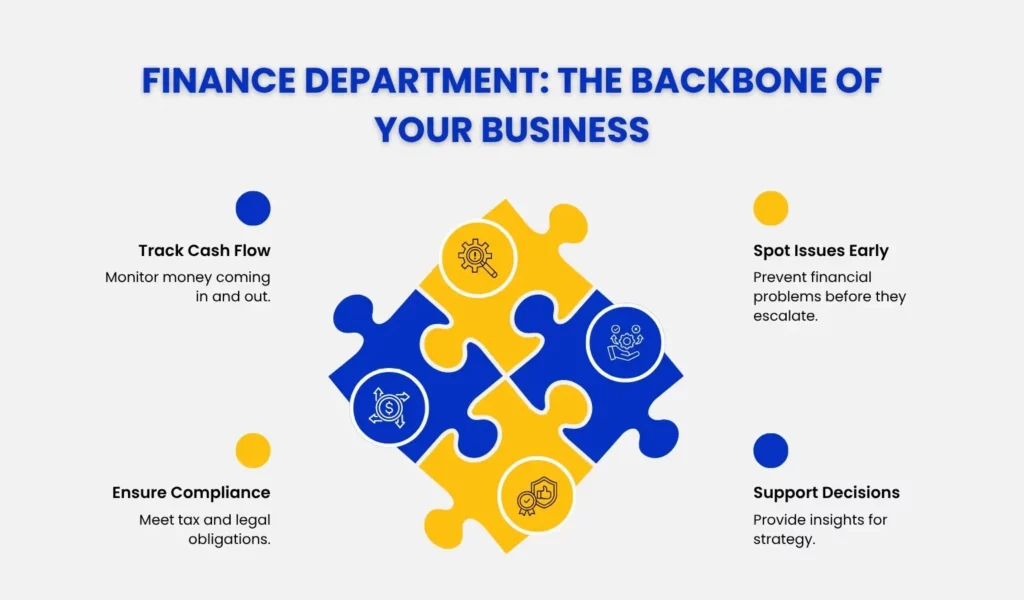
At its core, the finance department manages the financial health of the business. That means tracking money coming in, money going out, and making sure the business stays solvent and compliant. This is building-block base of all account’s preparation.
But it goes beyond bookkeeping. A well-run finance function also supports decision-making. It tells the business owner whether they can afford to hire, invest, or expand. It spots problems before they become crises.
In short, the finance department keeps the business on solid ground financially and helps leadership make better decisions.
What Are the Core Responsibilities of a Finance Department?
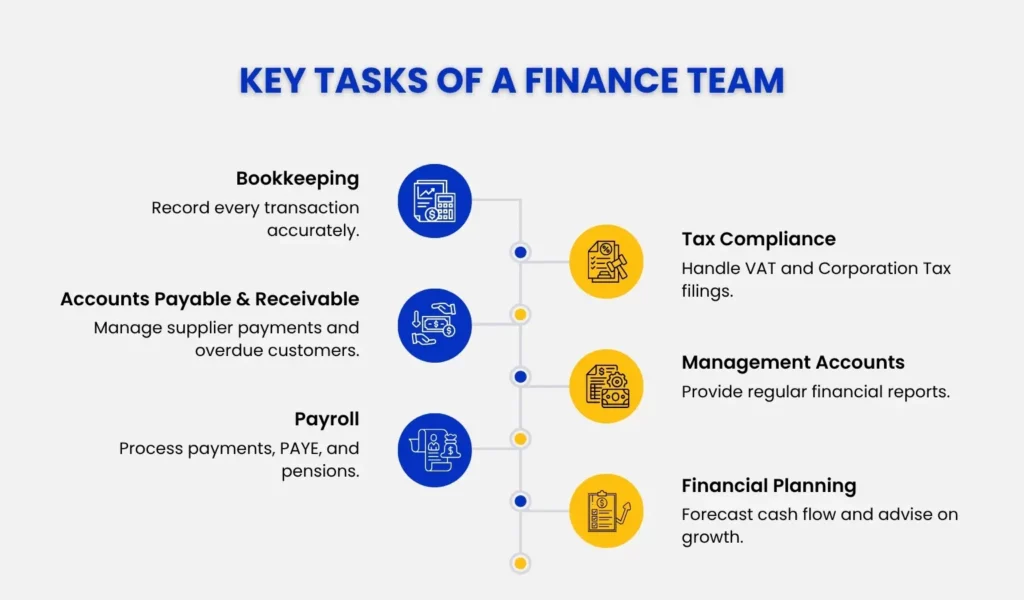
The responsibilities of a finance team typically fall into a few key areas.
- Bookkeeping and record keeping: Recording every transaction accurately. This is the foundation everything else is built on. Without clean records, nothing else works.
- Accounts payable and receivable: Making sure suppliers are paid on time and chasing customers who owe money. Cash flow management starts here.
- Payroll: Paying staff correctly and on time, processing PAYE and National Insurance, and managing pension contributions.
- VAT and tax compliance: Preparing and filing VAT returns, Corporation Tax returns, and ensuring the business meets all HMRC obligations on time.
- Management accounts: Producing regular financial reports, typically monthly, so the business can see how it is performing against budget and forecast.
- Financial planning and forecasting: Modelling future performance, managing cash flow forecasts, and helping leadership plan for growth or manage risk. This is the highest value a finance department will contribute. A finance department will advise whether a business’s plans are viable or not. Without good financial planning, managers would pile into business ventures not knowing if the underlying business idea stacks up or not.
Finance Team Structure Explained (By Business Size)
There is no single right structure. It depends on the size of the business, the complexity of its finances, and its growth ambitions.
- Sole traders and micro businesses: Most manage their own bookkeeping using software like Xero or QuickBooks, with an accountant handling year-end and tax. There is no dedicated finance team.
- Small businesses (up to about 20 staff): Often a part-time bookkeeper or finance manager, supported by an external accountant for compliance and tax planning. This hybrid model is common and cost-effective.
- Growing SMEs (20 to 100 staff): Likely to need a full-time Finance Manager or Financial Controller. A part-time or fractional Finance Director (FD) may also be brought in to handle strategy and reporting to investors or lenders.
- Larger businesses and scale-ups: A fully structured team with a full-time FD or CFO, a financial controller, management accountants, and a payroll and AP/AR team. External advisers still play a role, particularly for tax strategy.
Do Small Businesses Need a Finance Department?
Not in the traditional sense. A small business does not need a team. But it does need the functions that a finance team performs.
Accurate records, timely tax submissions, payroll, cash flow visibility: these are not optional. Without them, the business is flying blind and risking penalties.
And of course, any small business wants to grow and become a medium business over time. The finance team will say whether the expansions proposed actually make business sense or not. A Finance Department is therefore crucial even to small businesses.
In-House vs Outsourced Finance Department (UK Comparison)
Both options have merit. The right choice depends on your business stage, budget, and how much financial complexity you are dealing with.
In-house:
You have a dedicated person who knows the business well. They are available day to day. But hiring, training, and covering absence adds cost and management time. A full-time Finance Manager in the UK typically costs between £40,000 and £60,000 per year before employer add on-costs.
Outsourced:
You access a team of specialists for a monthly fee. Cover is built in, expertise is broader, and costs are usually lower than a full-time hire at equivalent skill levels. The trade-off is that the team is not physically on site.
For most SMEs at an early or mid-stage of growth, outsourcing is the more flexible and cost-effective option. You access a deeper skill pool for a price less than the local full-time equivalent of that experience.
What Does an Outsourced Finance Department Include?
An outsourced finance function can cover as much or as little as you need. A typical package for a growing SME might include:
- Monthly bookkeeping and bank reconciliation
- VAT return preparation and submission
- Payroll processing
- Monthly management accounts (which are your key business documents)
- Cash flow forecasting
- Year end accounts and Corporation Tax
- Access to a senior finance professional for strategic questions
The key advantage is scalability. As the business grows, the service grows with it, without the headcount and HR obligations of a full in-house team.
How to Set Up a Finance Department (or Transition to Outsourcing)
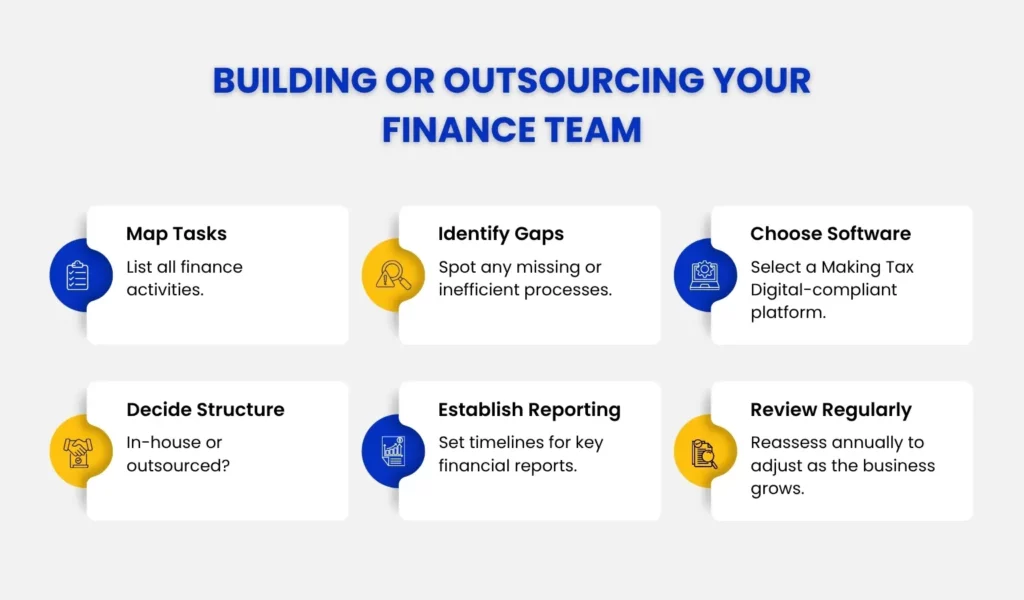
Whether you are building a finance function for the first time or moving from ad hoc arrangements to something more structured, the steps are broadly the same.
- Map your current finance tasks. List everything that currently gets done: bookkeeping, payroll, VAT, tax. Who does each task and how reliably is it done?
- Identify the gaps. Where are things falling behind, being done inaccurately, or simply not happening at all?
- Choose your software. Cloud accounting platforms like Xero or QuickBooks are the standard for UK SMEs. Make sure whatever system you use is Making Tax Digital compliant.
- Decide on in-house or outsourced. Based on your volume of transactions, budget, and growth plans, determine what structure makes sense.
- Establish a reporting rhythm. Agree on when management accounts will be produced, when you want to review cash flow, and what information you need to run the business.
- Review regularly. As the business changes, your finance needs will change too. Review the setup at least annually.
How Much Does a Finance Department Cost in the UK?
Costs vary widely depending on whether you hire in-house or outsource, and the size and complexity of your business.
In-house costs (approximate UK salary ranges):
- Bookkeeper: £25,000 to £35,000 per year
- Finance Manager: £40,000 to £60,000 per year
- Finance Director: £70,000 to £120,000+ per year
Remember to add employer National Insurance (currently 15%) and pension contributions on top of these figures.
Outsourced costs:
A fully outsourced finance function covering bookkeeping, VAT, payroll and management accounts typically costs between £1,000 and £3,500 per month for most SMEs, depending on transaction volume and the level of service required. This is often significantly cheaper than a full-time hire at a comparable level of expertise.
When Should You Outsource Your Finance Function?
There is no single trigger, but some common signals suggest the time is right.
- You are spending too much time on financial admin and not enough on running the business
- Your records are consistently behind or inaccurate
- You have missed a VAT deadline or had a penalty from HMRC
- You are growing and need monthly management accounts but do not have them
- You are approaching a funding round or bank application and your financial reporting is not investor-ready
- The cost of hiring in-house is not yet justified by your turnover
If any of these apply, it is worth having a conversation.
Conclusion
The finance department does far more than process invoices and file tax returns. It provides the financial visibility a business needs to grow with confidence.
For most SMEs, a fully staffed in-house finance team is not necessary or affordable. But the functions it performs are essential. Outsourcing gives you access to the right expertise at the right cost, without the overhead of full-time hires.
Why Choose Julian Hobbs & Co Outsourced Finance Department Services?
We work with small businesses and growing companies across the UK to provide outsourced finance support that actually makes a difference.
From bookkeeping and payroll to management accounts and strategic finance advice, we handle the numbers so you can focus on the business.
If you want to understand what an outsourced finance function could look like for your business, book a call with our team. We will explain the options clearly and give you a straightforward view of what it would cost.
People Also Ask:
What does the finance department do in simple terms?
It manages the financial records, payments, payroll, tax obligations and reporting for a business. It keeps the numbers accurate and makes sure the business stays compliant and financially informed.
Do sole traders need a finance department?
Not a team, but they do need the functions. Most sole traders manage their own bookkeeping with accounting software and use an accountant for their Self Assessment tax return and any VAT obligations.
Is a finance department the same as accounting?
They overlap but are not the same. Accounting focuses on recording and reporting financial information. A finance department also covers payroll, cash flow management, financial planning and compliance. An external accountant often supports or replaces the finance department function in smaller businesses.
How much does a small business finance team cost?
An in-house bookkeeper typically costs £25,000 to £35,000 per year. A Finance Manager can be £40,000 to £60,000. An outsourced finance function covering equivalent tasks generally costs between £1,000 and £3,500 per month, depending on the size and complexity of the business.
Can I outsource my entire finance department?
Yes. Many SMEs outsource all of their finance functions, from day-to-day bookkeeping to management accounts, payroll, VAT, and year-end accounts. It is a common and cost-effective model for businesses that are growing but not yet at a size where full-time hires make financial sense.
