

A budget in construction management is the approved spending plan for a project, covering materials, equipment, permits, risk and labour. Every cost is measured against it, and a budget reviewed weekly is the best way to finish a project without a funding crisis.
Imagine an office fit out worth £1.2 million. The contractor gets the job with a low bid and, in week six, discovers ductwork in the ceiling void, which is not documented on the drawings. Rerouting it costs £48,000. The client must approve additional funds, at which point the site manager will have to halt two other work packages while the funding approval is completed. The ductwork was not the real problem. The budget had no allowance for anything unexpected.
This guide explains how to plan a budget in construction management for UK projects, track it weekly and control it from first estimate to handover.
What Is a Budget in Construction Management?
A construction budget is the approved spending plan for a project, broken down by trade, phase and cost code. It sets the limit against which all committed and actual costs are tracked, and it changes only through a formally priced and approved variation.
The budget is a line by line projection of every expense a project may incur from design to handover. It is not the contract price. The contract price is what the client agrees to pay the contractor. The budget is the total the contractor or project owner plans to spend on the job, including risk allowances.
The purpose of a budget in construction management is threefold:
- Assigns a £ amount to every trade, phase and cost code
- Sets a baseline to measure actual costs against
- Shows whether a decision, such as a design change, is affordable
Budget vs Cost Estimate
What Costs Go Into a Construction Budget?
A budget in construction management covers two groups of costs: direct costs tied to a specific piece of work and indirect costs that support the whole project.
| Cost category | Examples |
| Labour | Site workers, supervisors, subcontractors. Reflect changes to employer National Insurance and minimum wage rates. |
| Materials | Concrete, steel, timber, glazing |
| Equipment | Crane hire, scaffolding, excavators |
| Subcontractors | Electrical, plumbing, HVAC packages |
| Permits and fees | Planning, building control, inspections |
| Site overheads | Temporary offices, utilities, site security |
| Insurance and bonds | Contract works (CAR) insurance, public liability, performance bonds |
| Professional fees | Architects, engineers, quantity surveyors |
| Contingency | Allowance for unforeseen events |
Allow for escalation, which is the rise in material and labour prices between pricing and purchase. Steel and timber prices have swung widely in recent years, so budgets for these items should carry an explicit escalation allowance. Cite BCIS Tender Price Index or ONS construction materials price data here at publishing.
How to Plan a Construction Budget: Step by Step
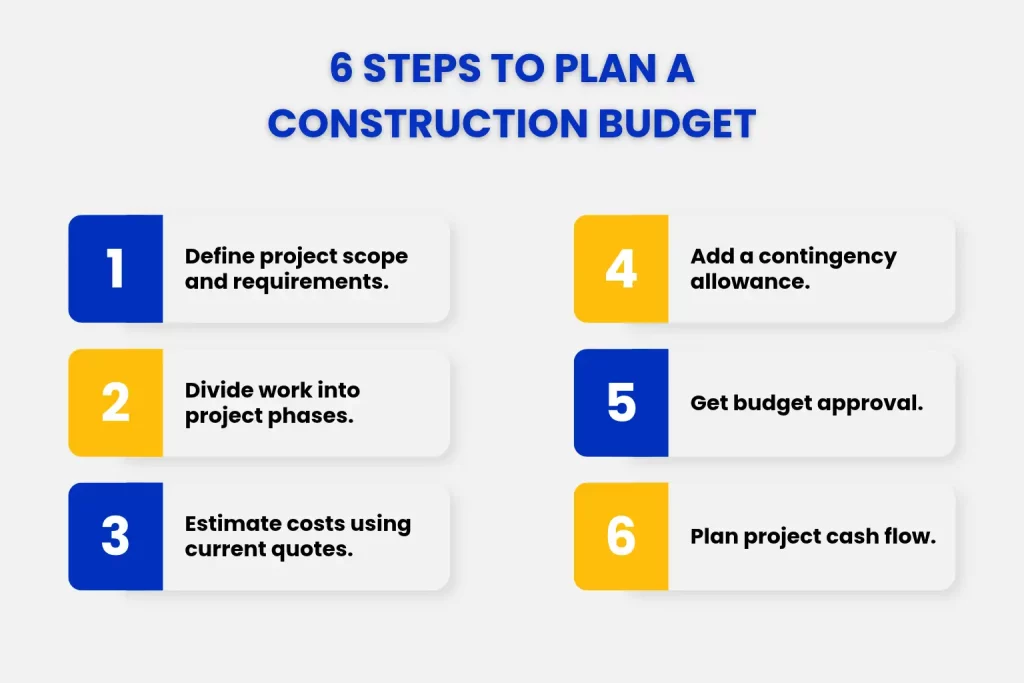
A budget in construction management works best when every cost is planned, approved and linked to the project timeline.
Follow these six steps to create a realistic budget and keep spending under control from the start.
Step 1: Define the Project Scope
List what is included and what is excluded. Unclear scope is a leading cause of disputes. Set out deliverables, specifications, quality requirements and the handover date.
Step 2: Break the Project into Phases and Cost Codes
Do not treat the project as a single lump. Split it into phases, for example groundworks, structure, envelope and fit out, and then into cost codes. Use a recognised structure so every cost has one home: NRM1 for cost planning in the UK, or CSI MasterFormat in the USA.
Step 3: Estimate Costs Using Current Quotes and Rates
Use quotes from suppliers and subcontractors, rates from similar completed projects and current price lists. If you reuse rates from earlier projects, adjust them for inflation first.
Step 4: Add Contingency
Contingency is a sum held back for risks and costs you cannot yet price. At early design stages, allowances of 10% to 15% are common, falling to 5% to 10% once design is complete. Refurbishing older buildings often needs more.
Step 5: Get the Budget Approved and Baselined
Have the client, project manager and finance lead sign off, then lock the baseline. Any later change should go through a formal, priced variation so the original and current figures can always be compared.
Step 6: Link the Budget to the Programme
Link spend to the programme to build a cash flow forecast. This shows when cash leaves and enters the business each month, so funding can be arranged before a large payment falls due. Allow for retention, CIS deductions and VAT treatment, covered in the UK payment section below.
How to Track and Control Costs During a Project
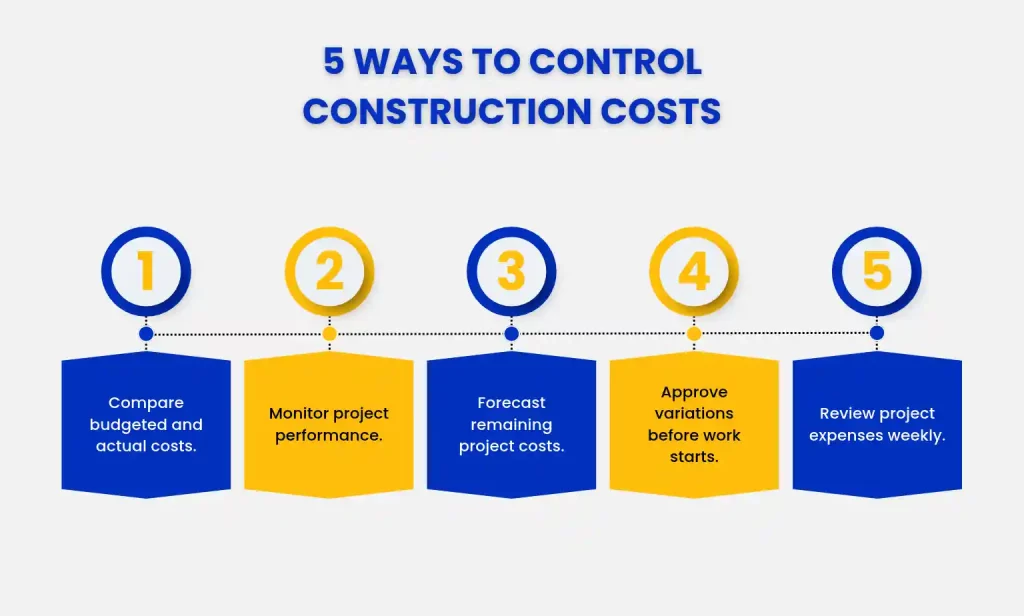
Planning creates the budget. Tracking is what keeps a budget in construction management alive. Apply these techniques weekly, not monthly.
- Compare budgeted, committed and actual costs: Committed costs are those already locked in through signed purchase orders and subcontracts, even if not yet invoiced.
- Earned value management: Track the Cost Performance Index (CPI = earned value divided by actual cost) and the Schedule Performance Index (SPI = earned value divided by planned value). A CPI below 1.0 means you are getting less than £1 of progress for every £1 spent.
- Cost to complete: Instead of only reporting what has been spent, forecast what it will cost to finish the project.
- Control variations: Price every variation before the work starts and record who approved it.
- Hold weekly cost reviews: A short weekly meeting between the site manager, quantity surveyor and project manager helps spot cost drift early, before it grows.
| Metric | What it tells you | Warning sign |
| CPI | Cost efficiency | Below 1.0 |
| SPI | Schedule efficiency | Below 1.0 |
| Contingency remaining | Risk cover left. | Falling faster than progress |
| Variance at completion | Forecast final overspend. | Any figure beyond approved tolerance |
Worked Example: A Simple Construction Budget Tracker
The table below shows how the columns work together in a budget in construction management on a small project. Figures are illustrative and in £.
| Package | Original budget | Approved variations | Revised budget | Committed | Actual to date | Forecast final cost | Variance |
| Groundworks | 120,000 | 8,000 | 128,000 | 126,000 | 90,000 | 126,000 | 2,000 |
| Structure | 310,000 | 0 | 310,000 | 305,000 | 150,000 | 318,000 | (8,000) |
| Fit out | 400,000 | 15,000 | 415,000 | 380,000 | 60,000 | 420,000 | (5,000) |
| Total | 830,000 | 23,000 | 853,000 | 811,000 | 300,000 | 864,000 | (11,000) |
Variance is revised budget minus forecast final cost, so a bracketed figure is an overspend. Here the forecast is £11,000 over the revised budget, so the team must decide whether to draw on contingency, find savings in the fit out, or seek a variation from the client.
UK Payment and Tax Factors That Affect Your Budget
UK payment rules change when cash arrives, which matters as much as the total cost. Build these into your budget in construction management and your cash flow forecast:
- Retention: a percentage of each valuation, often 3% to 5%, is held back until practical completion or the end of the defects period, so cash received is lower than the value of work done.
- Construction Industry Scheme (CIS): contractors deduct tax from payments to subcontractors and pay it to HMRC, which reduces the cash a subcontractor receives.
- VAT domestic reverse charge: for many construction services between VAT registered businesses, the customer accounts for the VAT instead of the supplier, which changes VAT cash flow.
- Payment notices: the Construction Act sets rules for payment and pay less notices, so know the dates in your contract.
- Contract and procurement route: JCT and NEC contracts, and fixed price versus cost reimbursable arrangements, decide who carries the risk of cost increases.
Best Software and Templates for Construction Budgeting
Spreadsheets work for small jobs, but they struggle with version control and live data once several people edit them. For a budget in construction management shared across a team, dedicated tools keep one source of truth.
| Tool | Best for | Key strength |
| Procore | Mid to large contractors | Budgeting linked to change orders and field data |
| Quickbase | Teams needing custom workflows | Configurable dashboards and cost tracking |
| ProjectManager | Project teams wanting task and cost views together | Gantt charts with budget tracking |
| Sage 300 Construction and Real Estate | Accounting-led firms | Job costing tied to financials |
| Microsoft Excel or Google Sheets | Small projects and early estimates | Low cost and flexibility |
When selecting, you’ll want to make sure the tool is able to:
- Import your cost codes
- Record committed costs as well as actuals
- Produce cash flow forecasts
- Link to the accounting system
- Handle UK requirements such as retention, CIS and VAT reverse charge
If using a template, make sure it has columns for original budget, approved variations, revised budget, committed cost, actual cost and forecast to complete.
5 Common Causes of Budget Overruns in Construction Projects
Cost overruns remain a significant challenge for the industry. A 2024 Homes England report, Optimism Bias and Contingency at Homes England, published on GOV.UK, drew on international data for buildings and found that 70% of projects overran their cost estimates, with an average cost overrun of 62% and an average schedule overrun of 32%. These figures compare outturn with estimates made at business case stage, so they show how much risk early estimates tend to miss. HM Treasury’s Green Book applies the same thinking through its optimism bias guidance.
These findings reinforce the need for realistic cost estimates, appropriate contingency allowances and regular budget monitoring throughout a construction project.
- Scope creep: Client requests are added during the build without approval of extra budget. Fix: require a priced variation for every addition.
- Poor initial estimates: Rushed or optimistic figures leave no margin. Fix: use current supplier quotes and have a second estimator check the figures.
- Design conflicts and errors: Structural and services drawings conflict, resulting in rework. Fix: run BIM clash detection before construction starts.
- Price rises and supply delays: Materials become more expensive or deliveries arrive late, which increases site overhead costs. Fix: secure prices early and include an escalation allowance.
- Weak cost monitoring: Reviewing costs only monthly means problems surface late. Fix: monitor committed costs and update the forecast weekly.
Keeping a Construction Budget on Track
A budget in construction management becomes a safeguard for a project only if it’s a living plan. Define scope clearly, base estimates on current supplier quotes, agree a realistic contingency and get the baseline approved before work starts.
Once work starts, review budgeted, committed and actual costs weekly, price every variation before it is instructed and update the forecast to completion so small variances are corrected while they are still small.
Getting this right is easier with a construction accountant who understands job costing, retention, CIS and VAT reverse charge. Julian Hobbs & Co works with UK construction businesses to set up reliable cost reporting, forecast cash flow and keep project budgets under control.
FAQs: Frequently Asked Questions
What is the purpose of a budget in construction management?
A construction budget sets a spending limit for each part of a project and gives a baseline to measure actual costs against. It helps managers spot overspending early, make changes knowing their cost and arrange funding so work does not stall.
Who is responsible for the budget in construction management?
The project manager is usually accountable for the budget, supported by a quantity surveyor or cost manager who builds it and tracks spend. The site manager controls daily costs, and the client or finance director approves the baseline and any significant change.
How much contingency should be included in a construction budget?
Most projects hold 5% to 10% of construction costs as contingency. Early design stages and complex work, such as refurbishing historic buildings, often need 10% to 15%. Reduce the figure only when risks have been dealt with, never just to win the job.
What is the difference between a construction budget and a cost estimate?
A cost estimate is a prediction of likely cost, refined as design develops. A construction budget is the approved spending plan built from that estimate, with allowances for risk, and it is changed only through formal approval.
How do you prevent cost overruns in construction management?
Write a clear scope statement, base estimates on current supplier quotes and hold a realistic contingency. Then track committed and actual costs weekly, price every variation before work starts and order long lead materials early. A weekly forecast to completion gives you time to act while the issue is still small.
How often should a construction budget be reviewed?
Review it weekly. Compare budgeted, committed and actual costs and update the forecast to completion, so overspends are caught while they can still be corrected.
