
Quick Brief
“James is running a profitable construction firm in Hertford. He is getting projects and on-paper his business seems to be doing pretty good.”
But, still at the end of each month, he’s in dilemma, asking “If we’re making money, and if yes, why does the cash feel tight?”.
The solution to it is – management accounts, that gets you a picture into how your business is performing right now – not twelve months ago, not at year end, but today.
This guide shows you exactly what a good management accounts example looks like for a UK small business, walks you through what should be in it, and explains why getting this right can be one of the most practical decisions you can make this year. By the end, you will also know what to look for, what to ask for, and why outsourcing this to specialists like Julian Hobbs makes sense.
What Management Accounts Are (in simple terms)
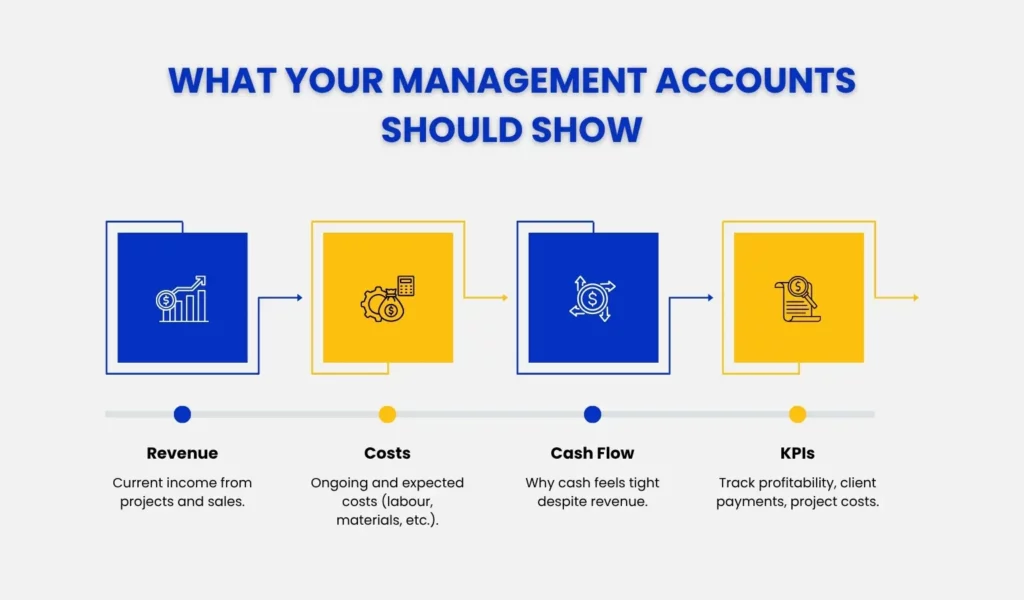
Management accounts are internal financial reports, produced monthly or quarterly – giving you a live view of your business performance. These reports are designed to help you manage active projects, costs and cash flow.
When James first heard about management accounts, he assumed: “Isn’t that just what my accountant already does?”
Well…. NO.
These reports, unlike your year end reports, are not filed with HMRC nor published at Companies House. They exist for you – solely, helping you answer:
- Are our projects actually profitable?
- Are labour and material costs under control?
- Why is cash tight despite strong revenue?
- Can we take on another project safely?
Think of it as an assisted feature for seamless navigation. It tells you where you are, how fast you are moving and whether there is a pothole ahead.
Management Accounts Example: A Real‑Style UK SME Report
To make this tangible, let’s use James’s business ‘XYZ Building Services LTD’ which has a turnover of roughly £650,000 -£700,000 a year. James has a good pipeline, a solid team and a reputation that earns repeat contracts. But he never had management accounts.
Below are the kind of reports snapshots – Julian Hobbs would produce for James each month:
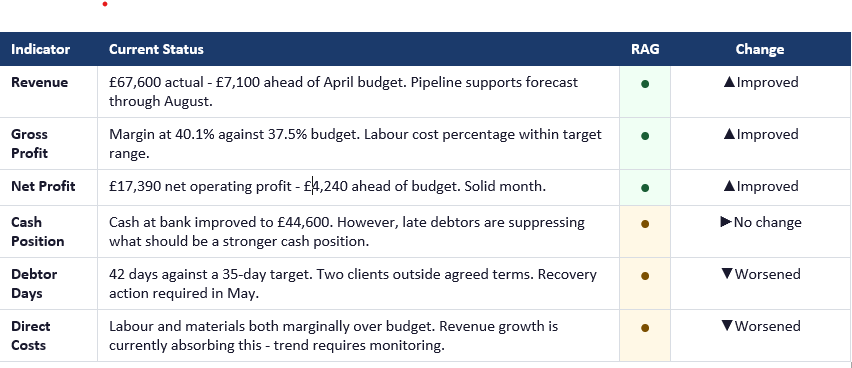
Executive Summary (Sample)
Income & Expenditure
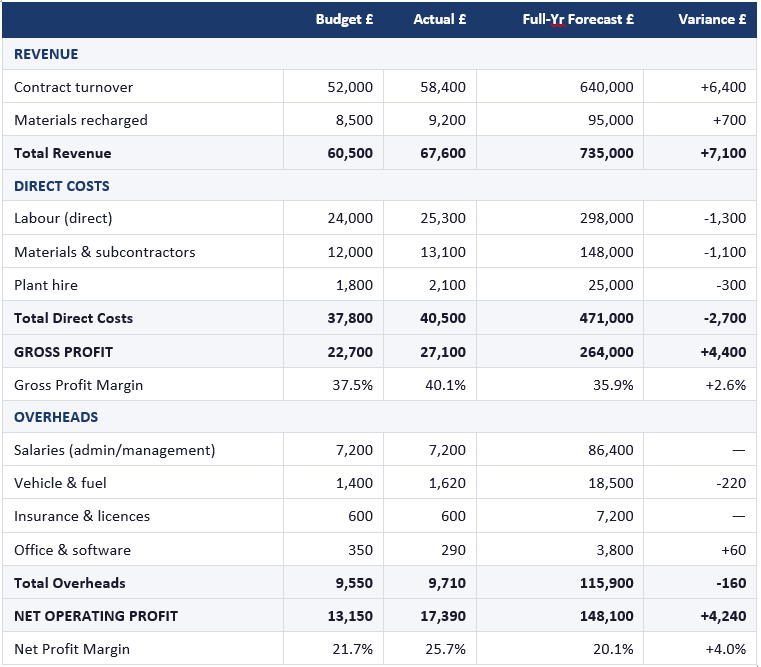
This tells James that March was a strong month, with profit beating expectations. It also signals that upcoming projects may need more labour and equipment, so pricing should be handled carefully when taking on new work.
Balance Sheet Snapshot
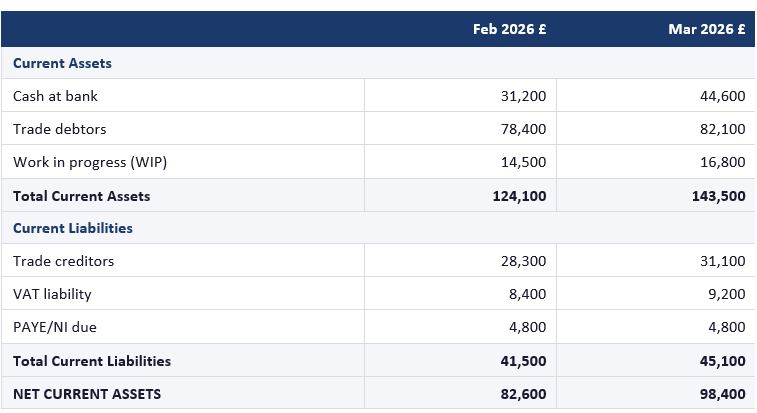
This helps James see clearly as to what is happening with his cash. Though the cash has gone up, so has the money he is owed. In simple terms, the profit is there, but it hasn’t come into the bank yet.
For the first time, James understands –
- How much clients owe across ongoing projects
- Supplier obligations
- And his actual financial position.
KPI Summary
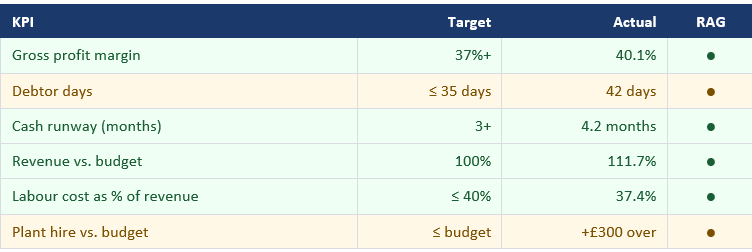
James gets to know that almost all his areas are performing well, except for the customer payments and plant hire costs.
- Instead of guessing performance, he can now manage it.
Issues for Further Review
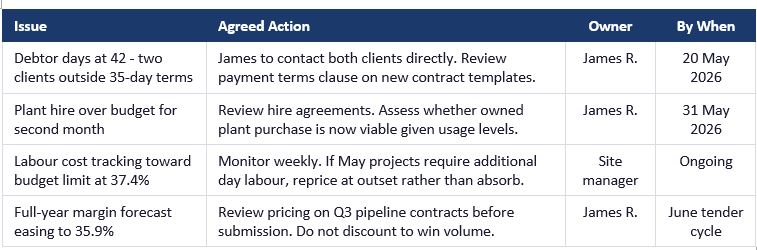
Every management accounts pack should close with a short action log – agreed terms with owners and deadlines. This is the section that turns reporting into accountability.
What Should be Included in Your Management Accounts?
Using the example and snapshots above as a guide, here’s what a useful management report should include – the kind you actually use, not one that gets ignored.
Profit & Loss with Budget Comparison and Forward Forecast
This shows how your business is performing. It compares what you planned with what actually happened, and also gives a view of where things are likely to end up by the year’s end.
In simple terms, it helps you understand:
- How you’re doing right now
- Whether you’re ahead or behind plan
- And if there’s still time to improve the outcome
Balance Sheet Snapshot
The management accounts version of this – is not overly detailed. It gives you a quick view of your net asset position, how cash has moved, what debtor owes you, and what you owe to the creditors.
A month-on-month comparison of this, helps spot cash pressure early, before it turns into a real problem – just like James experienced.
Cash Position & Forward Cash Flow
A snapshot of this section within your accounts – help you prepare for tax payments, salaries, slower months and seasonal dips. For James, this is the section that would have answered his monthly question years earlier.
KPIs With RAG Status
These are the key numbers that matter most to your business. These are generally shown in a simple red, amber, green format – making it easy to see what’s going well and what needs attention.
For XYZ Building Services LTD, this includes things like profit margins, how quickly customers pay, how long cash will last, sales vs plan, labour costs, and plant hire.
Ultimately – A Clear Commentary (Risks, Scenarios, and Actions)
Your management accounts will include a brief scenario table at the end – giving you and your accountants a shared picture of what could go wrong and by how much.
Without this, management accounts are a historical record. With it, they are a management tool.
How to Prepare Monthly Management Accounts (The Basics)
Before we delve into the preparation aspect, you can refer to our blog – “What are Monthly Management Accounts: Ultimate Guide” to know the basics, intricacies, its best practices and preparations, in detail.
Let’s dive into its basic snapshot version, so you know when and how you can prepare your management accounts – either by yourself or with the help of best accountants in Hertfordshire for complex business types.
Here is the process most UK SMEs follow:
- Record all financial activity:
Every invoice, expense, and payment is captured accurately. - Reconcile bank and supplier accounts:
- Bank balances match records
- Supplier and client balances are accurate
This step prevents “false profits” caused by incomplete data.
- Review outstanding invoices:
- Which clients haven’t paid?
- How long have they been outstanding?
For James, this highlighted delayed payments across two major projects.
- Prepare core financial reports:
- Profit & Loss
- Cash Flow
- Balance Sheet
- Analyse variances: Compare
- Actual vs expected
- Current vs previous months
This is where real insights start to appear.
- Add commentary and recommendations: Explain:
- What changed
- Why it changed
- What should happen next
This turns reporting into decision-making.
For most UK SMEs with fewer than 30 staff, management accounts should land within seven to ten working days of the month end. Arriving later than that, they are now too old to be fully useful.
For an in-depth, one-stop solution for understanding the preparation aspect, refer to our guide on Preparing Management Accounts: Step-by-Step.
Key Benefits of Management Accounts for SMEs
- Earlier visibility of cash flow problems: Accounting to bankingandfinance.com more than 80% of UK SMEs have experienced cash flow difficulties. Regular management accounts can give you a 30 to 90 days early warning before cash crunch. Only with standardised management accounts can you streamline your cash flow and reduce the risk of overpayment or underpayment.
- Better decisions, faster: Whether you are pricing a new contract, hiring a site manager or deciding whether to buy a plant – decisions made with real numbers beat decisions made on gut feel.
- Credibility with lenders and investors: SMEs who present banks/investors with three months of clean management accounts are far more likely to get approved fundings than ones with only a year end statutory report.
- Improved profitability: When you can see your gross margin changing month by month, you can act on it – renegotiate supplier costs, or identify projects where labour or plant hire is eating into profit.
To know more, read our Construction Cost Inflation guide to see why costs are rising and how to protect your margins.
- Year end accounts become cheaper: With books tidy every month, your year end accountant has less rework to do – which naturally means lower fees.
Do You Need to Outsource Your Management Accounts?
Honestly -Yes.
Being an owner already comes with the responsibility of balancing profitability and client satisfaction. With everything done in-house – either by you or your team – sooner or later you’re going to end up being caught in growing complexity, especially during periods of growth or seasonal dips.
Outsourcing helps ease that burden by giving you access to expertise and advanced resources, all under one roof.
As James’ business grew, so did the complexity – handling multiple projects, subcontractors, payment delays. He reaches a point where spreadsheets aren’t enough. He needs to consider outsourcing if
- He’s unable to track profitability per project
- Cash flow surprises are frequent
- Reports don’t reflect real business activity
- And he lacks time to analyse numbers properly.
Here are some of the strongest arguments for outsourcing:
- Objectivity: Since these external accountants and finance directors are not emotionally attached to the business, they can flag issues that an owner might otherwise rationalise or overlook.
- Technical accuracy: Outsourcing strengthens technical accuracy, which is often missed in in-house attempts, making the P&L misleading.
- Timeliness: Monthly accounts that are consistently late provide no value. A dedicated professional ensures they arrive on time, every month.
- Cost vs. value: Outsourcing management accounts usually delivers far superior output and value at a fraction of the cost compared to an in-house finance manager.
The question is not really ‘can I do this myself?’ Rather: ‘What will give my business the clearest financial picture each month – and at what cost?’
What To Do Next
If you’ve read this far and recognised your business – whether you’re a construction firm unsure of where cash is going, a sole trader who only sees numbers at year end, or a growing SME making decisions without a reliable monthly picture – then the next step is pretty simple.
Start with the basics. Even a monthly P&L with one comparison column is better than nothing. Build the habit. Add layers – cash flow, balance sheet snapshot, KPIs, a risks table, an issues log – as your reporting matures.
If you want it done properly from the start, with the kind of narrative commentary that actually informs decisions, then it is worth talking to a specialist.
Why Choose Julian Hobbs for Management Accounting Services?
Julian Hobbs & Co. is a renowned chartered accountant in Hertfordshire, UK known for custom, reliable management accounting services for UK SMEs and sole traders across construction, professional services, healthcare and retail.
You get full-fledged solutions – beyond compliance.
- Structured monthly reports with full clarity
- No jargon – straightforward explanations
- Timely delivery you can rely on
- Insights tailored to your business
Because at the end of the day, good management accounts don’t just report your business – they help you run it better.
Ready to see what your management accounts could look like? Contact Julian Hobbs today for a no-obligation conversation and see how we can help.
People Also Ask:
What is a management accounts example?
It’s a sample monthly report showing how your business performance is tracked and explained.
How are management accounts different from annual accounts?
Management accounts are frequent and internal. Annual accounts are yearly and for compliance.
Can I prepare management accounts myself?
Yes – but many UK SMEs find it difficult to maintain accuracy and consistency over time.
How often should management accounts be prepared?
Typically monthly, especially for growing businesses.
What is the benefit of management accounting outsourcing?
It gives you accurate, timely insights without the burden of managing it yourself.
How Julian Hobbs helps with preparing management accounts
By providing clear, decision-focused reports that help you stay in control of your finances.
